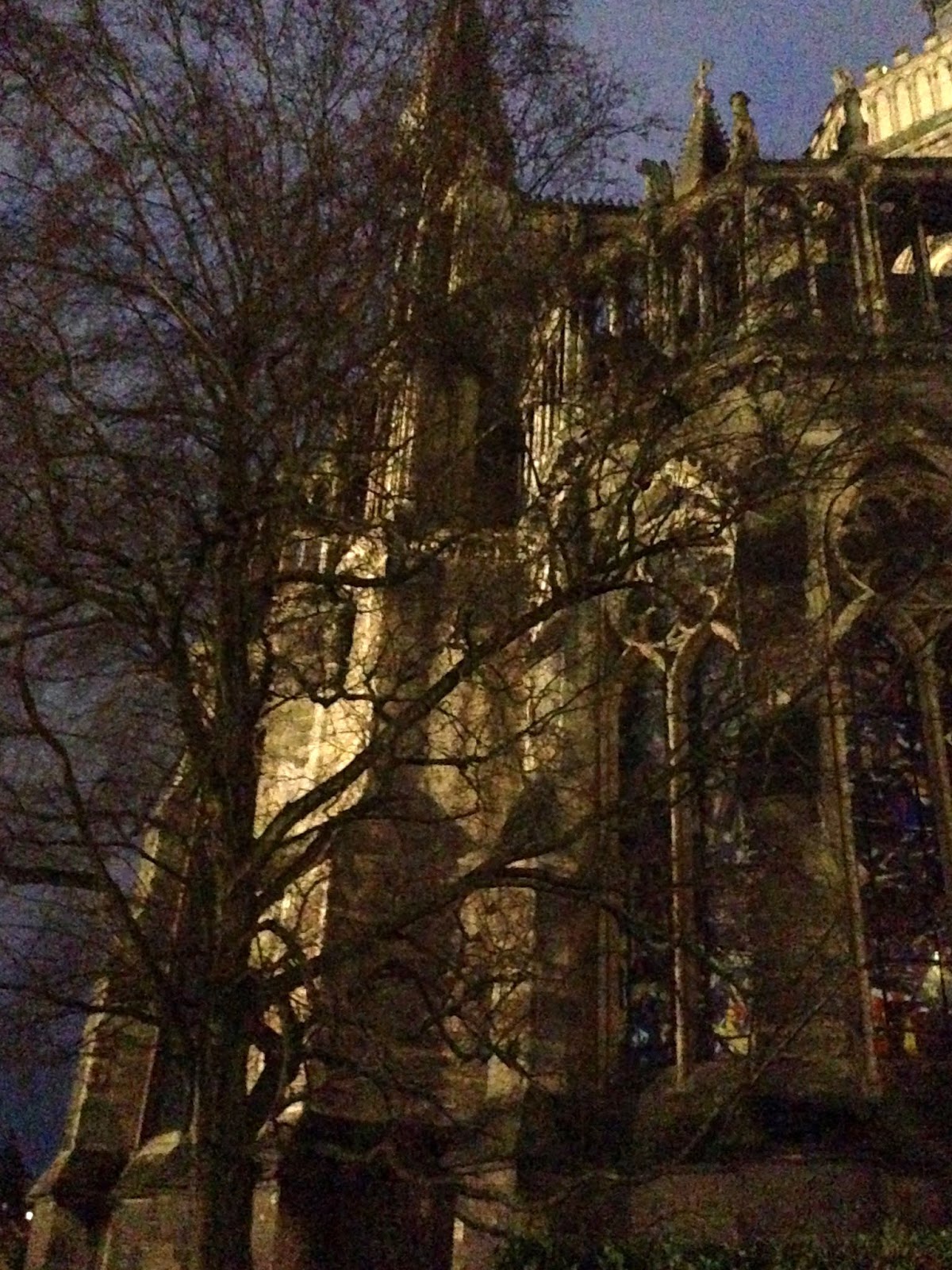
The history of France quietly reposes within a cathedral whose beauty rivals Notre-Dame de Paris.
Above: an excursion to the Alsace region found us stopping in Reims on the way where we were in for a rare treat, a visit to the cathedral at night
Cathédrale Nôtre-Dame de Reims
From Paris:
1 hour by train (TGV)
2-hour drive (1 1/2 hours if you drive like my French husband)
***
REIMS: City of Art and Culture
Reprint from 6-article series on the Champagne region
© Barbara Pasquet James
If you count each bottle, there are millions of reasons to visit Reims, Rheims in English, The City of Champagne.
However like many who come to this city of 180,000 in the heart of the Champagne-Ardenne, I came mostly to see its cathedral, larger than Nôtre-Dame de Paris, where almost all the kings of France were crowned.
I wanted to see the Smiling Angel's smile, to try and spot the ancestors of Christ on the portal over the main door, savor its gargoyles and flying buttresses and contemplate the Simon family's famed stained-glass “rosettes.” Marc Chagall’s trademark blues would dance with light, illuminating the small chapel behind the main altar. I saw all this, and more, and was not disappointed.
But Reims was, of course, much more than its magnificent cathedral. It is an ancient university town teeming with history, art, and culture. In pre-Roman times Reims was the fortified capital of a Gaulish tribe. Following the Roman conquest, its strategic position increased its military importance from the 3rd century onwards as the Romans tried to protect the city from invasion. At the same time, the city became Christian, and the first cathedral was built. The Roman forum, Cryptoporticus, and the Gate of Mars – the largest monumental arch built in the Roman world – are the only two structures to have survived from this period.
Today the city sits atop miles of tunnels connecting hundreds of massive crayeres (chalk pits) quarried by the Romans. They are now used by champagne houses such as Veuve Clicquot, Pommery, Taittinger and Ruinart to store countless bottles of a certain monk's delightfully accidental discovery. Ruinart's cellars have been designated a monument historique.
Not quite an hour and a half from Paris, Reims is sister ville fleurie to Canterbury, Saltzburg and Florence. Not surprisingly, the best place to start exploring is from the Cathedral, whose spires are visible for miles.
Some highlights:
* Notre-Dame Cathedral
The Cathedral of Our Lady, considered a masterpiece of Gothic art, was started in 1211. It was the cathedral of coronations for French kings in memory of the baptism of Clovis, the first King of France, by Saint Remi, probably on Christmas Day, 498. The Smiling Angel statue is on the left portal on the west front. Over the centuries there were alterations, fires and endless restorations. Joan of Arc assisted in the installation of Charles VII as king here in 1429, though she never lived to see the cathedral as it is today.
* Tau Palace
Formerly the Archbishop's Palace, this was built by Mansart and Robert de Cotte in 1690. It’s just behind the cathedral and houses its museum with tapestries, sculptures and artifacts from the kings' coronations. The "Salle du Tau," once used as a banqueting hall after coronations, is astounding.
* Saint-Remi Basilica and Saint-Remi Abbey Museum
The church is the largest Romanesque pilgrimage church in northern France and was built as a shrine to Saint Remi. It is a wonderful example of early Gothic style. The museum is the famous Benedictine Abbey of Saint-Remi, and reliquary of the Holy Ampula used for the coronation of French kings. It also houses the city's Museum of History and Archeology. Impressive collections from Pre-history to the Renaissance as well as a large military history section can be seen here. The chapter house dates from the 12th to 13th centuries.
Fine Arts Museum
This museum, housed in the former living quarters of the Abbey of Saint-Denis, has extensive collections from the Renaissance to today. In addition to early Renaissance canvasses, there is a series of Cranach portraits and a noteworthy collection of Corot paintings.
* Cryptoporticus
Semi-subterranean remains of the Roman Forum (200 A.D.).
Museum of The Surrender
This map room in Eisenhower's headquarters was where the signing of the surrender of German troops took place, May 7, 1945. The original table and chairs where each of the participants sat are still in place.
Musée Automobile Reims Champagne
Vintage cars, motorbikes, pedal cars, several thousands of miniatures and period publicity posters; renews exhibitions regularly.
To discover Reims' art, museums, ancient abbeys and churches, not to mention the city's restaurants and cafés, plan on staying for at least a couple of days. And not to forget, Reims' champagne houses open their doors to visitors all year round.
Getting there:
By train: From Paris, Gare de l’Est - 12 connections daily www.sncf.fr
By car: A4-E50 to Reims
Where to eat:
Café du Palais
(stone's throw from the cathedral; ceiling by Jacques Simon)
(lunch)
Restaurant "Le Parc" - Les Crayeres
(dinner)
Visit:
Tourism Office
Tourisme Champagne-Ardenne
***
* UNESCO World Heritage sites